
Published on 17 March 2026
Condominium Photovoltaics: Common System, Private System, and Assembly Rules
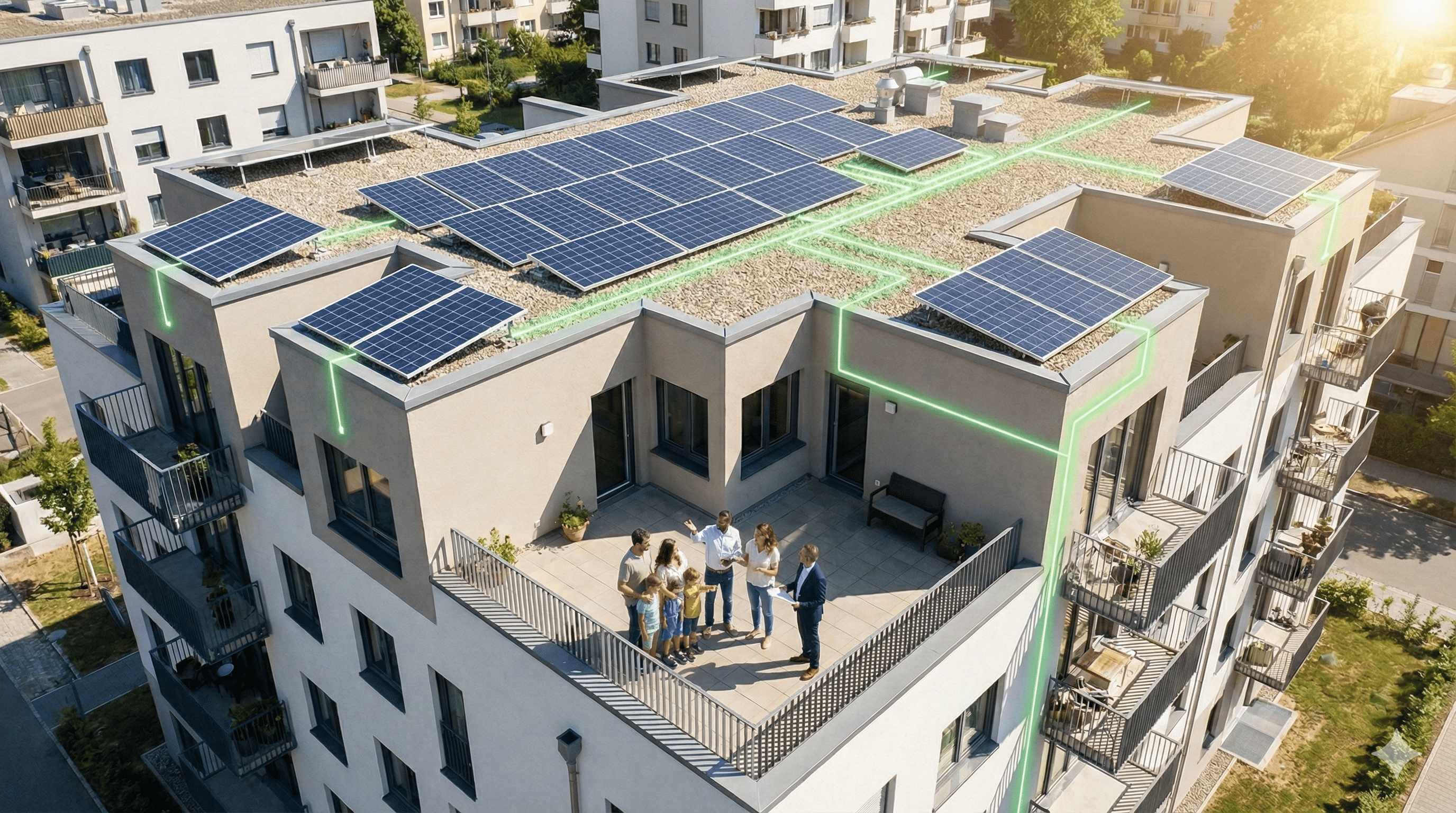
Condominium photovoltaics is an increasingly popular solution to reduce the building's energy costs and enhance common areas like the roof and flat roof. However, to avoid disputes and delays, it is essential to accurately distinguish who the system owner is, which utilities will be served (common areas or homes), and which spaces are used.
Below is an informative and practical guide, designed to clarify the main available options and the typical rules that come into play in a condominium setting.
Condominium Photovoltaics: What Are the Options?
When discussing solar in a condominium, there are essentially three distinct models:
Condominium Photovoltaic System for Common Areas
The system is approved and managed by the condominium. The energy produced is used to power condominium consumption (stairs, elevators, gates, pumps, outdoor lighting, etc.). This is the most "straightforward" case regarding energy use.
Shared System with Collective Self-Consumption
This is a configuration where multiple subjects in the same building share the energy produced. It is often the most effective route when the goal is to generate benefits for domestic utilities (individual homes) and not just for the common areas.
Private System in the Condominium (Individual Owner)
An owner installs a system to serve their own unit. In some cases, they can use suitable common areas (e.g., roof/flat roof), following specific rules and mandatory communications to the administrator.
Condominium Photovoltaic System for Common Areas
What it entails (in practice)
A "centralized" condominium system starts as a collective decision and requires organized management:
Technical assessment (space, exposure, shading, installable power)
Economic assessment (costs, allocation, payback time)
Scope definition: which consumption it covers and how to manage any excess energy
Assembly and Resolutions
For systems on common areas, an assembly resolution is normally required according to condominium rules. Operationally, it is advisable to arrive at the assembly with:
A brief technical report (even preliminary)
2–3 comparable quotes
A clear proposal on cost and benefit allocation
Produced Energy: Common Areas and "Surplus"
If the system is designed solely for common areas, self-consumption mainly occurs on those loads. Energy that is not immediately consumed can be managed through grid-connected system mechanisms (e.g., energy sale/transfer), but this depends on the chosen technical/administrative setup.
Private Photovoltaics in a Condominium: What the Individual Can Do
General Principle
Private solar in a condominium is possible even when, for technical reasons, it is necessary to use (in whole or in part) a suitable common area. In these cases:
The administrator must be formally informed
The assembly can discuss methods and precautions, especially if the intervention affects common areas (cable routing, mountings, conduits, access, etc.)
What the Assembly Can Evaluate (or Limit)
Generally, condominium discussions focus on three aspects:
Building safety and stability
Architectural decorum
Equal use of common areas (i.e., ensuring other owners can also use that space in the future) This is the most delicate point: it's often not about "if it can be done," but how to do it without restricting the rights of others or creating an unmanageable precedent.
Condominium Roof and Space Allocation: The Most Conflict-Prone Issue
When multiple owners want to install panels, surface area becomes the real constraint. To reduce friction, it's useful to address immediately:
Map of available areas (actual usable surface, not just geometric)
Technical zones (passages, maintenance distances, safety areas)
Allocation criteria (equivalent portions, progressive assignments, time priority, etc.)
There is no "magic formula" valid for all condominiums: the most effective solution is one that makes the process replicable and defensible over time, avoiding ad hoc decisions.
Collective Condominium Self-Consumption: When It Makes Sense and What Changes
Collective self-consumption in a condominium becomes relevant when the goal is to move beyond the "common areas only" limit and bring energy value to participating residential units. In simple terms:
In simple terms:
The system is single (or part of a common system)
Multiple subjects join the setup
The logic is a shared model with allocation rules, not "to each their own system"
It is often the option to evaluate when:
Roof space is limited (making a unified project more convenient)
The condominium wants a structured, non-fragmented approach
The goal is to maximize local use of the produced energy
Operational Checklist for a Condominium Photovoltaic Project
Define the goal: Common areas? Homes? Both (collective self-consumption)?
Verify constraints and feasibility: Space, shading, orientation, access, building/landscape constraints (if any).
Set up the process with the administrator: Formal communications, document collection, adding the item to the assembly agenda.
Prepare an "assembly-ready" proposal: Comparable quotes, allocation scheme, future management and maintenance hypothesis.
Preventively manage the roof issue: Space allocation and technical rules, to avoid later conflicts.
Essential FAQs
Essential FAQs Can the assembly outright ban a private system on the roof? In practice, the assembly tends to intervene on methods, safety, decorum, and use of common areas, especially when the installation involves modifications or significant occupation of common space.
Does condominium solar only serve common areas? Not necessarily. If the goal is to serve homes as well, you usually evaluate a collective self-consumption setup or a private system per unit (when space and conditions allow).
What is the most common mistake? Starting with panel selection without defining the model (condominium, private, collective) and without clarifying the roof/allocation issue.
Conclusion
Condominium photovoltaics is a feasible and often highly cost-effective project, but it requires an orderly approach: choosing the correct model, transparently managing the assembly process, and above all, preventively managing roof spaces. When these elements are clear, the technical side becomes much easier to administer, and consensus among owners tends to grow.
'%3e%3crect%20width='12'%20height='12'%20fill='white'/%3e%3cpath%20d='M11.25%206.00073C11.2512%206.15454%2011.2044%206.3049%2011.1162%206.43092C11.028%206.55693%2010.9027%206.65233%2010.7578%206.70385L7.78406%207.78526L6.70312%2010.7585C6.64985%2010.9021%206.55392%2011.0259%206.42823%2011.1133C6.30253%2011.2007%206.1531%2011.2476%206%2011.2476C5.8469%2011.2476%205.69746%2011.2007%205.57177%2011.1133C5.44608%2011.0259%205.35015%2010.9021%205.29687%2010.7585L4.21594%207.78479L1.24218%206.70385C1.09865%206.65058%200.974862%206.55465%200.887446%206.42896C0.800029%206.30327%200.753174%206.15383%200.753174%206.00073C0.753174%205.84763%200.800029%205.69819%200.887446%205.5725C0.974862%205.44681%201.09865%205.35088%201.24218%205.2976L4.21594%204.21667L5.29687%201.24292C5.35015%201.09938%205.44608%200.975595%205.57177%200.888178C5.69746%200.800762%205.8469%200.753906%206%200.753906C6.1531%200.753906%206.30253%200.800762%206.42823%200.888178C6.55392%200.975595%206.64985%201.09938%206.70312%201.24292L7.78453%204.21667L10.7578%205.2976C10.9027%205.34913%2011.028%205.44453%2011.1162%205.57054C11.2044%205.69656%2011.2512%205.84692%2011.25%206.00073Z'%20fill='%231C95C2'/%3e%3c/g%3e%3cdefs%3e%3cclipPath%20id='clip0_5437_68169'%3e%3crect%20width='12'%20height='12'%20fill='white'/%3e%3c/clipPath%3e%3c/defs%3e%3c/svg%3e) Monocrystalline
Monocrystalline Single-phase
'%3e%3cpath%20fill-rule='evenodd'%20clip-rule='evenodd'%20d='M2.42569%200.790688C2.60794%200.236437%203.39194%200.236437%203.57419%200.790688L3.97894%202.02094L5.20919%202.42569C5.76344%202.60794%205.76344%203.39194%205.20919%203.57419L3.97894%203.97894L3.57419%205.20919C3.39194%205.76344%202.60794%205.76344%202.42569%205.20919L2.02094%203.97894L0.790688%203.57419C0.236437%203.39194%200.236437%202.60794%200.790688%202.42569L2.02094%202.02094L2.42569%200.790688ZM7.34869%201.84619C7.55544%201.21794%208.44444%201.21794%208.65119%201.84619L9.27044%203.72944L11.1537%204.34869C11.7819%204.55544%2011.7819%205.44444%2011.1537%205.65119L9.27044%206.27044L8.65119%208.15369C8.44444%208.78219%207.55544%208.78219%207.34869%208.15369L6.72944%206.27044L4.84619%205.65119C4.21769%205.44444%204.21769%204.55544%204.84619%204.34869L6.72944%203.72944L7.34869%201.84619ZM4.59869%206.30819C4.40869%205.73069%203.59119%205.73069%203.40119%206.30819L2.94519%207.69519L1.55819%208.15144C0.980687%208.34144%200.980687%209.15844%201.55819%209.34844L2.94519%209.80469L3.40144%2011.1917C3.59144%2011.7692%204.40844%2011.7692%204.59844%2011.1917L5.05469%209.80469L6.44169%209.34844C7.01919%209.15844%207.01919%208.34144%206.44169%208.15144L5.05469%207.69519L4.59869%206.30819Z'%20fill='%231C95C2'/%3e%3c/g%3e%3cdefs%3e%3cclipPath%20id='clip0_5437_68218'%3e%3crect%20width='12'%20height='12'%20fill='white'/%3e%3c/clipPath%3e%3c/defs%3e%3c/svg%3e) Polycrystalline
Polycrystalline