
Published on 09 April 2026
Vehicle to Grid and Vehicle to Home: the electric car as a domestic energy asset
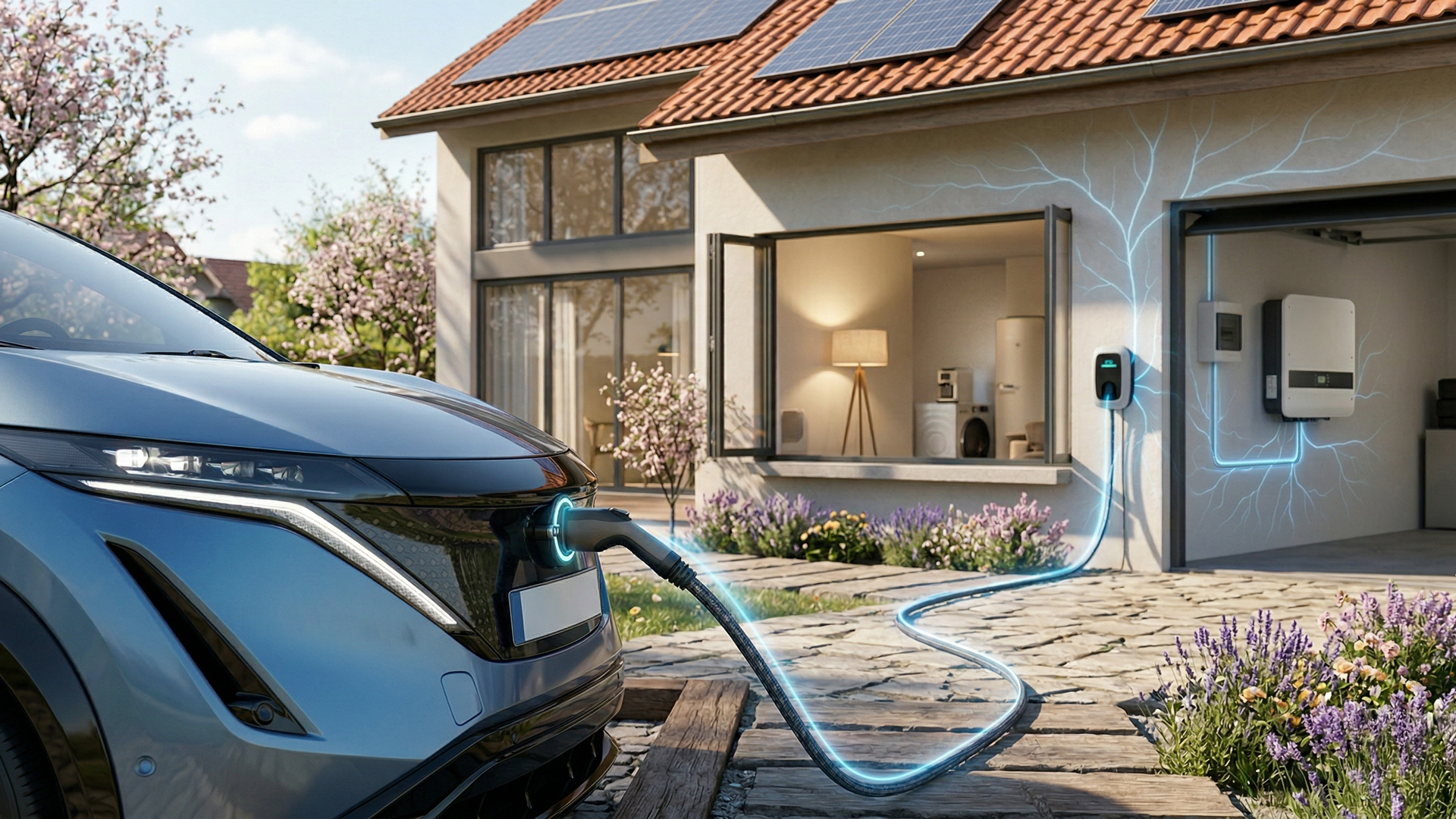
Electric cars have transformed the way we commute. But there is an even quieter transformation underway, concerning not the miles driven, but the kWh stored: the car as an active component of the domestic energy system.
We are talking about Vehicle to Grid (V2G) and Vehicle to Home (V2H). These are technologies that allow an electric car to do something counterintuitive: not just charge from the grid, but also give energy back—to the public grid in the case of V2G, or to your own home in the case of V2H.
The starting point is a simple but often underestimated fact: cars sit idle about 70% of the time. For most of the day, your four-wheeled energy tank is parked, inactive, and unused. Vehicle to Grid and Vehicle to Home were born to change this equation.
What is Vehicle to Grid (V2G)?
Vehicle to Grid is the technology that enables a bidirectional energy flow between the electric car and the public power grid. The car is no longer just an energy consumer: it also becomes a supplier.
This has a specific role in the energy ecosystem: grid stabilization. Renewable sources like solar panels produce energy intermittently—when there is sun they produce, at night or on cloudy days they don't. Electric cars connected to the grid can buffer these imbalances, absorbing energy during times of overproduction and feeding it back during times of deficit.
The data that makes this prospect credible is precisely the usage statistic: a car is only used for driving 30% of the time. The remaining 70% is time when the battery is available for other purposes. On an aggregate level, millions of parked cars represent a distributed storage system of massive proportions.
What is Vehicle to Home (V2H)?
Vehicle to Home is the domestic version of this concept. The energy flow does not go to the public grid, but into your own home. The electric car becomes, for all intents and purposes, an alternative—or complementary—storage system to the stationary batteries installed alongside solar panel systems.
The difference compared to a traditional home battery is the available capacity. Stationary solar storage batteries typically range between 5 and 15 kWh. The battery of a modern electric car starts at 40 kWh and easily reaches 70-100 kWh. It's a completely different order of magnitude.
How much energy does a car battery really have?
To put this into concrete terms: an average home consumes about 8-10 kWh per day. A 60 kWh battery could theoretically cover the domestic needs for 5-6 consecutive days, even without solar production and without drawing from the grid.
In practice, V2H systems set a guaranteed minimum reserve—typically 20-30% of the capacity—which is excluded from domestic use to ensure you always have driving range. But the available margin remains significant.
How it works technically: what you need for V2H
To integrate Vehicle to Home into a house, you need more than just any electric car and a standard plug. You need specific components that work in a coordinated manner.
The car must support bidirectional charging. Not all electric vehicles have this feature. The main standards available today are CHAdeMO—used by Nissan and some Japanese models—and CCS Combo 2 with the ISO 15118 protocol, which is spreading across a growing number of European models. Before evaluating anything, you must check your vehicle's compatibility.
You need a bidirectional wallbox. The classic one-way charger is not enough. You need a certified device to manage the energy flow in both directions.
The heart of the system is the inverter. For those who already have a solar system, V2H integration requires a bidirectional hybrid inverter capable of simultaneously managing the solar panels, the vehicle's battery, and the domestic loads. A traditional inverter—designed exclusively to convert DC from the panels into AC for the grid—is not compatible with this setup and will need to be replaced or paired with a dedicated management system.
The role of the inverter in the V2H ecosystem
For those who already have a solar panel system and want to integrate Vehicle to Home, the central bottleneck is almost always the inverter. Traditional models installed over the last decade are not designed to handle complex bidirectional flows. Replacing it with a new-generation hybrid inverter is often the first necessary step.
High-end bidirectional hybrid inverters come with hefty price tags. However, the used and end-of-line solar market offers concrete alternatives: inverters removed from revamping plants, or never-installed models (New Old Stock) with years of useful life ahead, available at a fraction of the list price.
For those who want to approach V2H while optimizing entry costs, this is an avenue worth exploring.
FAQ
Can an electric car really power my house?
Yes, provided that the car supports bidirectional charging and the home system is equipped with a wallbox and an inverter compatible with V2H. The vehicle's battery works as a storage system, generally with a higher capacity than traditional stationary batteries.
How long does the car battery last if I use V2H?
It depends on the battery capacity and the home's consumption. With a 60 kWh battery and a 30% minimum reserve, you have about 42 kWh available for the house—enough to cover 4-5 days of average consumption.
Does V2H work even without a solar panel system?
Yes. V2H is independent of solar power: the car can charge from the grid during off-peak rate hours and supply energy to the house during peak hours. Integrating it with a solar panel system, however, maximizes the benefits by allowing you to charge the vehicle directly with energy produced on-site.
Which cars support Vehicle to Home today?
The most widespread models with V2H support are the Nissan Leaf and Nissan Ariya (CHAdeMO standard). A growing number of models from other manufacturers are adopting the bidirectional CCS protocol. Before proceeding with any installation, it is essential to verify your vehicle's technical specifications.
Do I need to modify my existing solar system to use V2H?
In almost all cases, yes. V2H integration requires replacing or upgrading the inverter with a bidirectional hybrid model and installing a certified wallbox. From a bureaucratic standpoint, this is a modification to an existing system that requires updating your paperwork with local grid authorities. You must rely on a certified installer.
'%3e%3crect%20width='12'%20height='12'%20fill='white'/%3e%3cpath%20d='M11.25%206.00073C11.2512%206.15454%2011.2044%206.3049%2011.1162%206.43092C11.028%206.55693%2010.9027%206.65233%2010.7578%206.70385L7.78406%207.78526L6.70312%2010.7585C6.64985%2010.9021%206.55392%2011.0259%206.42823%2011.1133C6.30253%2011.2007%206.1531%2011.2476%206%2011.2476C5.8469%2011.2476%205.69746%2011.2007%205.57177%2011.1133C5.44608%2011.0259%205.35015%2010.9021%205.29687%2010.7585L4.21594%207.78479L1.24218%206.70385C1.09865%206.65058%200.974862%206.55465%200.887446%206.42896C0.800029%206.30327%200.753174%206.15383%200.753174%206.00073C0.753174%205.84763%200.800029%205.69819%200.887446%205.5725C0.974862%205.44681%201.09865%205.35088%201.24218%205.2976L4.21594%204.21667L5.29687%201.24292C5.35015%201.09938%205.44608%200.975595%205.57177%200.888178C5.69746%200.800762%205.8469%200.753906%206%200.753906C6.1531%200.753906%206.30253%200.800762%206.42823%200.888178C6.55392%200.975595%206.64985%201.09938%206.70312%201.24292L7.78453%204.21667L10.7578%205.2976C10.9027%205.34913%2011.028%205.44453%2011.1162%205.57054C11.2044%205.69656%2011.2512%205.84692%2011.25%206.00073Z'%20fill='%231C95C2'/%3e%3c/g%3e%3cdefs%3e%3cclipPath%20id='clip0_5437_68169'%3e%3crect%20width='12'%20height='12'%20fill='white'/%3e%3c/clipPath%3e%3c/defs%3e%3c/svg%3e) Monocrystalline
Monocrystalline Single-phase
'%3e%3cpath%20fill-rule='evenodd'%20clip-rule='evenodd'%20d='M2.42569%200.790688C2.60794%200.236437%203.39194%200.236437%203.57419%200.790688L3.97894%202.02094L5.20919%202.42569C5.76344%202.60794%205.76344%203.39194%205.20919%203.57419L3.97894%203.97894L3.57419%205.20919C3.39194%205.76344%202.60794%205.76344%202.42569%205.20919L2.02094%203.97894L0.790688%203.57419C0.236437%203.39194%200.236437%202.60794%200.790688%202.42569L2.02094%202.02094L2.42569%200.790688ZM7.34869%201.84619C7.55544%201.21794%208.44444%201.21794%208.65119%201.84619L9.27044%203.72944L11.1537%204.34869C11.7819%204.55544%2011.7819%205.44444%2011.1537%205.65119L9.27044%206.27044L8.65119%208.15369C8.44444%208.78219%207.55544%208.78219%207.34869%208.15369L6.72944%206.27044L4.84619%205.65119C4.21769%205.44444%204.21769%204.55544%204.84619%204.34869L6.72944%203.72944L7.34869%201.84619ZM4.59869%206.30819C4.40869%205.73069%203.59119%205.73069%203.40119%206.30819L2.94519%207.69519L1.55819%208.15144C0.980687%208.34144%200.980687%209.15844%201.55819%209.34844L2.94519%209.80469L3.40144%2011.1917C3.59144%2011.7692%204.40844%2011.7692%204.59844%2011.1917L5.05469%209.80469L6.44169%209.34844C7.01919%209.15844%207.01919%208.34144%206.44169%208.15144L5.05469%207.69519L4.59869%206.30819Z'%20fill='%231C95C2'/%3e%3c/g%3e%3cdefs%3e%3cclipPath%20id='clip0_5437_68218'%3e%3crect%20width='12'%20height='12'%20fill='white'/%3e%3c/clipPath%3e%3c/defs%3e%3c/svg%3e) Polycrystalline
Polycrystalline